
Known Production Shergold Models
Other Shergolds made on special order (the prime example being Mike Rutherfords
superb splitable double-neck) are known
to exist, but below I have tried to make a full list of the generally available
production models.
If anyone reading this has a model or configuration that is not mentioned, I would love to hear about it. Please email me the details...
I am also trying to gather original pricing information for the models.
If anyone reading this has a model or configuration that is not mentioned, I would love to hear about it. Please email me the details...
I am also trying to gather original pricing information for the models.


Descriptions and Variations


6 string and 12 string guitars.
25½" scale length
25½" scale length
The most common of all the Shergolds in its "Custom" guise, these were produced in volume between 1976 and 1981, and
in smaller numbers (to customer order) from 1982 until the official relaunch in 1991.
These guitars are very solid and have the characterisiticly superb neck that all the Shergolds share. The versatile electronics make these ideal general purpose guitars, but they are especially popular with rhythm players as the output from the pickups isn't over-powering. The six string Masquerader was the only Shergold guitar model in continuous production through the 'independent' Shergold period between 1975 to 1991 - the twelve string models only became available from 1976.
"Post Hayman"
Early examples (1975 to early 1976) have Hayman necks fitted (distinquished by a more waisted headstock design with extra carved moulding around the headstock edges, and often a black plastic plug filling the original Hayman logo hole under the Shergold badge) and a large scratchplate which the pickups are mounted on, and an ex-Hayman three piece bridge.
"First all Shergold"
From 1976 the first all-Shergold models appear - the necks become the less ornate Shergold style (though technically this is also a Hayman design as it appears on the Hayman Modular and Comet models in 1975 just before the Hayman brand folded) with a nailed-on plastic shield logo, the bridge becomes a six piece unit, but the large scratchplate from the earlier model is still used and each pickup has two mounting screws.
"Transitional Custom"
In 1977 the models labelled "Custom" on the scratchplate start to appear. These look identical to the earlier model with the full size scratchplate mounting the pickups, but most now use three screws to hold each pickup allowing some forward-back pitching adjustment. These Masqueraders are generally referred to as "Transitional" Custom models. This advert from January 1977 shows both models available at the same time - the Custom would cost you an extra £10!
"Custom"
Later in 1977 the "true" Custom models appear. These have the pickups fitted on individual mounting rings and a small separate scratchplate. These are the most common models, and where made in volume between 1977 and 1981. A good number of examples are known from the period between 1982 and 1991 (when Shergold officially retreated from the guitar business) and are easily recognisable when a clear finish is used as they usually have a laminated maple and mahogany center section to the body, and the headstock badge changes from plastic to a foil sticker.
"Mark 2"
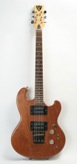
In 1981, the "Mark 2" model appears in advertising literature (along with the Nu Meteor and Mark 2 Marathon). The production Mark 2 was a mahogany or ash body (though of the few known examples, only mahogany ones have been found so far) in an unfilled satin polyurethane wood finish, no scratchplates, through-body controls, and a rosewood fingerboard on a glued in neck. Some reviews from 1981 mention the Custom Masquerader being available with an ash body which appears to have been a prototype that was sent out for review - and this review seems to have been particularly persuasive - "Oh for a Masquerader with no scratchplate and controls directly mounted into the wood!".
"Limited Edition"
In 1991, Shergold briefly returned to official manufacturing. To differentiate these guitars from the Custom Masquerader's that Shergold had been 'unofficially' building since 1982, the new Masquerader had "Limited Edition" engraved on the a black scratchplate (all earlier models use a clear perspex plate with the text screen printed in reverse on the back before being over-sprayed in matt black), but despite looking nearly identical in styling to the earlier Custom models, the Custom tag was dropped from the name. Some body contouring was added to the shape with a shallow scallop on the back and a slight slope on the front - very similar to a Str*t.
The evolution of the Masquerader can be traced through these pictures in the Gallery:
These guitars are very solid and have the characterisiticly superb neck that all the Shergolds share. The versatile electronics make these ideal general purpose guitars, but they are especially popular with rhythm players as the output from the pickups isn't over-powering. The six string Masquerader was the only Shergold guitar model in continuous production through the 'independent' Shergold period between 1975 to 1991 - the twelve string models only became available from 1976.
"Post Hayman"
Early examples (1975 to early 1976) have Hayman necks fitted (distinquished by a more waisted headstock design with extra carved moulding around the headstock edges, and often a black plastic plug filling the original Hayman logo hole under the Shergold badge) and a large scratchplate which the pickups are mounted on, and an ex-Hayman three piece bridge.
"First all Shergold"
From 1976 the first all-Shergold models appear - the necks become the less ornate Shergold style (though technically this is also a Hayman design as it appears on the Hayman Modular and Comet models in 1975 just before the Hayman brand folded) with a nailed-on plastic shield logo, the bridge becomes a six piece unit, but the large scratchplate from the earlier model is still used and each pickup has two mounting screws.
"Transitional Custom"
In 1977 the models labelled "Custom" on the scratchplate start to appear. These look identical to the earlier model with the full size scratchplate mounting the pickups, but most now use three screws to hold each pickup allowing some forward-back pitching adjustment. These Masqueraders are generally referred to as "Transitional" Custom models. This advert from January 1977 shows both models available at the same time - the Custom would cost you an extra £10!
"Custom"
Later in 1977 the "true" Custom models appear. These have the pickups fitted on individual mounting rings and a small separate scratchplate. These are the most common models, and where made in volume between 1977 and 1981. A good number of examples are known from the period between 1982 and 1991 (when Shergold officially retreated from the guitar business) and are easily recognisable when a clear finish is used as they usually have a laminated maple and mahogany center section to the body, and the headstock badge changes from plastic to a foil sticker.
"Mark 2"
In 1981, the "Mark 2" model appears in advertising literature (along with the Nu Meteor and Mark 2 Marathon). The production Mark 2 was a mahogany or ash body (though of the few known examples, only mahogany ones have been found so far) in an unfilled satin polyurethane wood finish, no scratchplates, through-body controls, and a rosewood fingerboard on a glued in neck. Some reviews from 1981 mention the Custom Masquerader being available with an ash body which appears to have been a prototype that was sent out for review - and this review seems to have been particularly persuasive - "Oh for a Masquerader with no scratchplate and controls directly mounted into the wood!".
"Limited Edition"
In 1991, Shergold briefly returned to official manufacturing. To differentiate these guitars from the Custom Masquerader's that Shergold had been 'unofficially' building since 1982, the new Masquerader had "Limited Edition" engraved on the a black scratchplate (all earlier models use a clear perspex plate with the text screen printed in reverse on the back before being over-sprayed in matt black), but despite looking nearly identical in styling to the earlier Custom models, the Custom tag was dropped from the name. Some body contouring was added to the shape with a shallow scallop on the back and a slight slope on the front - very similar to a Str*t.
The evolution of the Masquerader can be traced through these pictures in the Gallery:
Post Hayman
1975-1976

1975-1976

First all Shergold
1976

1976

Transitional
Custom
1977

Custom
1977

Custom
1977-...

1977-...

Mark 2
1981
1981

Limited Edition
1991

1991

Trivia Spot: In earlier advertising material, the name "Masquerader" is commonly
mispelt as "Masquerador" - even on some Shergold
produced advertising.
As far as is known, this spelling never made it as far as appearing on a guitar.


4 string bass / 6 string guitar
4 string bass / 12 string guitar
6 string guitar / 12 string guitar
4 string bass / 8 string bass
25½" scale length (guitar)
34" scale length (bass)
4 string bass / 12 string guitar
6 string guitar / 12 string guitar
4 string bass / 8 string bass
25½" scale length (guitar)
34" scale length (bass)
The Custom Double was introduced in 1977 and made in quantity from 1978 to satisfy the demand for
Shergold Double Neck guitars created by the prominent use by Mike Rutherford
of a custom made Shergold double neck.
Essentially this is the double neck fusion of the Custom Masquerader guitars and Marathon bass. Some other true custom versions were made, such as two custom bass necks (8 and 6 string, fretted and fretless etc).
In a mixed guitar and bass combination the bass neck is usually fitted lowermost, and a twelve string uppermost, with the 6 string neck taking the other position where appropriate. Alternate arrangements of the necks could be had on custom orders - as on this example...
Two output jacks are fitted, one for standard mono signal, and the other for stereo.
Essentially this is the double neck fusion of the Custom Masquerader guitars and Marathon bass. Some other true custom versions were made, such as two custom bass necks (8 and 6 string, fretted and fretless etc).
In a mixed guitar and bass combination the bass neck is usually fitted lowermost, and a twelve string uppermost, with the 6 string neck taking the other position where appropriate. Alternate arrangements of the necks could be had on custom orders - as on this example...
Two output jacks are fitted, one for standard mono signal, and the other for stereo.
Trivia Spot: Mike was guaranteed a unique instrument, so along
with concerns of final unit cost and weight, the concept of splitting the body into two guitars
was dropped. A standard Custom Double was subsequently used by John Goodsall of Brand-X, and more recently
by Julian Cope.

6 string and 12 string single neck guitars.
4 string, 6 string and 8 string single neck basses (all available fretless).
Double Necks to custom order.
25½" Scale length (guitar)
34" scale length (4 and 8 string bass)
30" scale length (6 string bass)
4 string, 6 string and 8 string single neck basses (all available fretless).
Double Necks to custom order.
25½" Scale length (guitar)
34" scale length (4 and 8 string bass)
30" scale length (6 string bass)
Prototyped in 1975, and in production from 1976.
Similar in design and general appearance to the Masquerader but with a removable and interchangable electronics module in place of the normal fixed control plate. This concept continues from the Hayman "Modular", designed by former Vox employee Bob Pearson just before the collapse of the Hayman company, which had interchangable electronics mounted in panels the same size as the Modulator.
The basses tend to feel headstock heavy when compared to a Marathon or J-Bass, but are more versatile instruments thanks to the two 16 pole pickups and the interchangeable electronics.
Seven production modules were made - further details are here. One module that was originally postulated was a module with a built in radio transmitter to allow wireless playing!
Similar in design and general appearance to the Masquerader but with a removable and interchangable electronics module in place of the normal fixed control plate. This concept continues from the Hayman "Modular", designed by former Vox employee Bob Pearson just before the collapse of the Hayman company, which had interchangable electronics mounted in panels the same size as the Modulator.
The basses tend to feel headstock heavy when compared to a Marathon or J-Bass, but are more versatile instruments thanks to the two 16 pole pickups and the interchangeable electronics.
Seven production modules were made - further details are here. One module that was originally postulated was a module with a built in radio transmitter to allow wireless playing!
Trivia Spot: The Modulator appears to have been outside the Barnes and Mullins
distribution deal - they never feature on any B&M price lists or adverts, and the Modulator brochures
don't mention B&M either. Early reviews support this as you had to
contact Shergold directly to enquire about the Modulator.
A downside of this is that we have very patchy original price information.

4 string 34" scale, 6 string 30" scale (both available fretless)
Occasional 8 string 34" scale basses.
Occasional 8 string 34" scale basses.
Evolved from the Hayman 4040 bass which was
built by Shergold for the Dallas music company, and along side the Masquerader the Marathon was part of the Shergold
range throughout the life of the company, though (while still available to custom order) was not part of the official
relaunch in 1991.
The versions of this instrument have been known in the past as the Mark 1 and Mark 1a, as the minor revisions were not known when this entry was originally written. To make later changes easier should any more variations become apparent, we are now (2013) recommending the use of the less numeric naming system, as set out below.
"Big plate" - (formerly Mark 1)
These are easy to spot as they have a large mounting plate for the pickup that stretches all the way back to the bridge. They will also often have a black plastic plug in the headstock behind the Shergold logo from where the original Hayman medallion would have been inset while Shergold were using up previously made Hayman stock. The control plate has a selector switch for mono or stereo output on the single stereo socket.
"Single socket" - (formerly Mark 1a)
The cosmetic change from the Big plate model is the removal of the pickup mounting scratchplate which is replaced with a standard pickup mounting ring.
"Twin socket (shorthorn)" - (formerly Mark 1a or Mark 1b)
To reduce the complexity of the Single socket variant, the circuitry removes the lever switch from the control plate and uses two mono sockets on the body to give the equivalent behavior - the switch contacts in the sockets are used to 'automatically' select mono or stereo output without the need for a switch or a special splitter cable that (according to advertising) was previously included with the basses.
"Twin socket (longhorn)" - (formerly Mark 1a or Mark 1c)
In production from 1980, these are electrically identical to the shorthorn variant but the upper body horn is slightly longer (the body ends level with the 13th fret, compared with the shorthorn where the body extends only to between the 15th and 14th frets) to improve the often criticised tendancy to a headstock heavy balance on a strap.
"Mark 2"
In 1981, a small number of four string Marathons officially designated as the "Mark 2" were produced. These feature a mahogany body following the longhorn outline but using through body mounted controls, a glued in neck with a rosewood fingerboard, and a single 16 pole pickup (wired in mono). At least one bass was reviewed as a Mark 2 in 1981, but appears to be a prototype model based on the standard longhorn design and fittings, but with an ash body.
The four string Marathon, particularly in it's final longhorn variant or with the heavier mahogany body of the Mark 2, is better balanced for strap playing than the Modulator bass due to the slightly longer body and lighter machine heads, though is less sonically versatile due to the simpler electronics.
The eight string basses are strung in the same way a twelve string guitar is, with 4 courses of octaved string pairs over a standard width bass neck. The six string bass necks are about 5mm wider than the standard bass neck throughout the (4 inches shorter) scale, and also have 24 frets and a brass nut.
The four and eight string (pre-Mark 2) basses are fitted with a single split pickup and stereo controls and wiring - the pickup is in effect two mini-humbuckers in the same casing. The stereo effect is derived by putting the pickup coils under the first and second strings on one channel and the third and fourth the other half of the pickup. The main drawback with this arrangement is that in mono mode, the two halves of the pickup are connected in parallel, giving low output. Common owner alterations to the electronics are to add a toggle switch to flip between parallel and series connection of the windings, and a second switch to bypass the tone and volume network.
The six string Marathons are fitted with Modulator style 16 pole pickups and mono wiring. A small toggle switch is provided between the volume and tone controls to give single coil, humbucker and phased arrangement of the pickup coils. Several four string Marathon's have been seen fitted with the 16 pole pickup, but do not have the toggle switch arrangement.
The versions of this instrument have been known in the past as the Mark 1 and Mark 1a, as the minor revisions were not known when this entry was originally written. To make later changes easier should any more variations become apparent, we are now (2013) recommending the use of the less numeric naming system, as set out below.
"Big plate" - (formerly Mark 1)
These are easy to spot as they have a large mounting plate for the pickup that stretches all the way back to the bridge. They will also often have a black plastic plug in the headstock behind the Shergold logo from where the original Hayman medallion would have been inset while Shergold were using up previously made Hayman stock. The control plate has a selector switch for mono or stereo output on the single stereo socket.
"Single socket" - (formerly Mark 1a)
The cosmetic change from the Big plate model is the removal of the pickup mounting scratchplate which is replaced with a standard pickup mounting ring.
"Twin socket (shorthorn)" - (formerly Mark 1a or Mark 1b)
To reduce the complexity of the Single socket variant, the circuitry removes the lever switch from the control plate and uses two mono sockets on the body to give the equivalent behavior - the switch contacts in the sockets are used to 'automatically' select mono or stereo output without the need for a switch or a special splitter cable that (according to advertising) was previously included with the basses.
"Twin socket (longhorn)" - (formerly Mark 1a or Mark 1c)
In production from 1980, these are electrically identical to the shorthorn variant but the upper body horn is slightly longer (the body ends level with the 13th fret, compared with the shorthorn where the body extends only to between the 15th and 14th frets) to improve the often criticised tendancy to a headstock heavy balance on a strap.
"Mark 2"
In 1981, a small number of four string Marathons officially designated as the "Mark 2" were produced. These feature a mahogany body following the longhorn outline but using through body mounted controls, a glued in neck with a rosewood fingerboard, and a single 16 pole pickup (wired in mono). At least one bass was reviewed as a Mark 2 in 1981, but appears to be a prototype model based on the standard longhorn design and fittings, but with an ash body.
The four string Marathon, particularly in it's final longhorn variant or with the heavier mahogany body of the Mark 2, is better balanced for strap playing than the Modulator bass due to the slightly longer body and lighter machine heads, though is less sonically versatile due to the simpler electronics.
The eight string basses are strung in the same way a twelve string guitar is, with 4 courses of octaved string pairs over a standard width bass neck. The six string bass necks are about 5mm wider than the standard bass neck throughout the (4 inches shorter) scale, and also have 24 frets and a brass nut.
The four and eight string (pre-Mark 2) basses are fitted with a single split pickup and stereo controls and wiring - the pickup is in effect two mini-humbuckers in the same casing. The stereo effect is derived by putting the pickup coils under the first and second strings on one channel and the third and fourth the other half of the pickup. The main drawback with this arrangement is that in mono mode, the two halves of the pickup are connected in parallel, giving low output. Common owner alterations to the electronics are to add a toggle switch to flip between parallel and series connection of the windings, and a second switch to bypass the tone and volume network.
The six string Marathons are fitted with Modulator style 16 pole pickups and mono wiring. A small toggle switch is provided between the volume and tone controls to give single coil, humbucker and phased arrangement of the pickup coils. Several four string Marathon's have been seen fitted with the 16 pole pickup, but do not have the toggle switch arrangement.


6 string and 12 string single neck guitars
Available as double necks.
25½" scale length (guitar)
34" scale length (bass)
Available as double necks.
25½" scale length (guitar)
34" scale length (bass)
Prototyped in 1977 and put into production in 1978, these otherwise seemingly normal Shergolds have one major point that makes them stand apart from
the others - the neck. The neck joint on the Cavalier is a hybrid of bolt-on and through-neck.
A large rebate (the width of the fingerboard, and about 15mm deep) is cut into the back of the body from the neck pocket right down to below the bridge plate. The rebate is cut deep enough for the pickup rebates from the front of the body to come right through.
At the front of the body, a shortened neck pocket is cut into the body. Across this pocket, just below the level of the fingerboard, a 10mm tenon projects forwards by about 5mm. This mates firmly with the rebate cut into the heel of the neck. Two large screws pass down from the bridge base plate, through the body and fix into the end of the neck extension once slotted into the rebate on the reverse of the body.
Norman Houlder has drawn this sketch of the neck arrangement that he designed, and has the final word on it:
 "The Cavalier was conceived through frustration at Jack's inability to get away from
those lumps of functional wood.
"The Cavalier was conceived through frustration at Jack's inability to get away from
those lumps of functional wood.
I was always looking for some new innovation, and listening to player's comments about sustain and the accessibility to the sharp end of the scale, I devised the neck with a heel which made it possible, and connected it through to the bridge so there was no sustain loss (the spring box of the Hayman was always in my mind, albeit that was a pain to install). I think I found it. Also I wanted to sculpture the body, I can't remember if I got away with that? [Ed: I'm afraid not Norman - purely functional slab sides!]
Jack overpriced it so it never really got off to a decent start!"
A large rebate (the width of the fingerboard, and about 15mm deep) is cut into the back of the body from the neck pocket right down to below the bridge plate. The rebate is cut deep enough for the pickup rebates from the front of the body to come right through.
At the front of the body, a shortened neck pocket is cut into the body. Across this pocket, just below the level of the fingerboard, a 10mm tenon projects forwards by about 5mm. This mates firmly with the rebate cut into the heel of the neck. Two large screws pass down from the bridge base plate, through the body and fix into the end of the neck extension once slotted into the rebate on the reverse of the body.
Norman Houlder has drawn this sketch of the neck arrangement that he designed, and has the final word on it:
 "The Cavalier was conceived through frustration at Jack's inability to get away from
those lumps of functional wood.
"The Cavalier was conceived through frustration at Jack's inability to get away from
those lumps of functional wood.I was always looking for some new innovation, and listening to player's comments about sustain and the accessibility to the sharp end of the scale, I devised the neck with a heel which made it possible, and connected it through to the bridge so there was no sustain loss (the spring box of the Hayman was always in my mind, albeit that was a pain to install). I think I found it. Also I wanted to sculpture the body, I can't remember if I got away with that? [Ed: I'm afraid not Norman - purely functional slab sides!]
Jack overpriced it so it never really got off to a decent start!"
Trivia Spot: The Cavalier seems originally to have been intended to be a replacement for
the Modulator - a prototype 12 string with a Modulator scrtachplate is shown in a Shergold trade show advert
with the text stating compatibility with the Modulator modules; the same prototype is reviewed by Sounds
again stating it is a replacement for the Modulator;
and a book review of the same guitar calls it the
"Modulator 2". Production Cavalier models were fitted with standard fixed switchgear, and the
Modulator continued to be made as it was, though rarely advertised due to it not being distributed by Barnes and Mullins.

6 string single neck guitars.
25½" scale length
25½" scale length
In common with other Shergold models the Meteor was originally derived from a discontinued Hayman model -
the Comet.
The first Meteors (starting from 1975) were simply Hayman Comets with different scratchplate text and a Shergold badge
covering the Hayman logo on the headstock.
Unusually for a guitar that was the baby of the range, and hence cheaper than the others, the controls on the early examples for pickup selection, tone, volume and phasing are mounted through the body from the back, rather than being fixed to a front mounted scratchplate. As well as requiring routing from the reverse of the body, the controls need holes drilled through from the back, and the back needs an inset cover plate. The normal option of controls on scratchplates is far simpler as only a single routing operation and an oversized scratchplate is required.
The budget nature of the model meant that it had only a single humbucker, and a simple three saddle bridge.
The Meteor Deluxe (or "Meteor Twin Pickup" in various adverts) begins production in November of 1976 and appears in adverts in January 1977. The design was changed to use the normal (and cheaper) front mounted control plate, gains a second humbucker at the neck, and a six saddle bridge.
To keep this model in it's position as the "entry level" option in the range (though the price did increase when the twin pickup model was introduced), some corners were cut. The machine heads are cheap unnamed and unadjustable units in place of the Schaller tuners used on the rest of the range; the headstock string guides fitted to all other guitar models are eliminated; and the fingerboard edges are left unbound with the fret ends exposed. That said, the same care has still been given to the profile of the neck and the overall finish of the guitars as on the other models in the range. The electronics are on a par with those of the Masquerader, and it actually has a better G*bson style pickup selector that its big brothers would really have benefited from having.
Unusually for a guitar that was the baby of the range, and hence cheaper than the others, the controls on the early examples for pickup selection, tone, volume and phasing are mounted through the body from the back, rather than being fixed to a front mounted scratchplate. As well as requiring routing from the reverse of the body, the controls need holes drilled through from the back, and the back needs an inset cover plate. The normal option of controls on scratchplates is far simpler as only a single routing operation and an oversized scratchplate is required.
The budget nature of the model meant that it had only a single humbucker, and a simple three saddle bridge.
The Meteor Deluxe (or "Meteor Twin Pickup" in various adverts) begins production in November of 1976 and appears in adverts in January 1977. The design was changed to use the normal (and cheaper) front mounted control plate, gains a second humbucker at the neck, and a six saddle bridge.
To keep this model in it's position as the "entry level" option in the range (though the price did increase when the twin pickup model was introduced), some corners were cut. The machine heads are cheap unnamed and unadjustable units in place of the Schaller tuners used on the rest of the range; the headstock string guides fitted to all other guitar models are eliminated; and the fingerboard edges are left unbound with the fret ends exposed. That said, the same care has still been given to the profile of the neck and the overall finish of the guitars as on the other models in the range. The electronics are on a par with those of the Masquerader, and it actually has a better G*bson style pickup selector that its big brothers would really have benefited from having.
Trivia Spot: The emergence of the "Deluxe" name is supposed to have been
the result of an over-eager advertising editor at distributor Barnes and Mullins. The improved
Meteor (that is, those produced after the Hayman Comet parts had been exhausted) is described as a
"Meteor Twin Pickup Deluxe Guitar" in Shergold advertising from 1977.
Later versions did away the "twin pickup"
bit and used the remainder in the new adverts. Subsequently, when customers and dealers began asking
for "Meteor Deluxe" guitars, it was decided to add the "Deluxe" tag
permanently and on the truss rod cover, though the scratchplate text remains as simply 'Meteor'.

6 string single neck guitars.
24¾" scale length
24¾" scale length
Identical in shape to the Meteor, but with a large white Str*t style
scratchplate, rosewood fingerboard, three single coil pickups, one volume and two tone controls,
Str*t style five-way selector switch below the bridge pickup, and a Masquerader style bridge.
The output jack is fitted flat onto the scratchplate. The electronics are in traditional Str*t arrangement (the only production Shergold to use single coil pickups - Kent Armstrong units), but it is the centre pickup that is slanted, instead of the more usual bridge pickup.
The scale is ¾" shorter than the standard Shergold necks fitted to earlier models, carries 24 frets, and has a laid back headstock unlike all other Shergolds that have a dished, flat headstock. The necks are surplus stock from Ned Callan Cody guitars left over since 1974 (the necks were amongst other parts offered for sale in 1980).
It is thought that only 40 Nu Meteors were made following their introduction in 1980.
The output jack is fitted flat onto the scratchplate. The electronics are in traditional Str*t arrangement (the only production Shergold to use single coil pickups - Kent Armstrong units), but it is the centre pickup that is slanted, instead of the more usual bridge pickup.
The scale is ¾" shorter than the standard Shergold necks fitted to earlier models, carries 24 frets, and has a laid back headstock unlike all other Shergolds that have a dished, flat headstock. The necks are surplus stock from Ned Callan Cody guitars left over since 1974 (the necks were amongst other parts offered for sale in 1980).
It is thought that only 40 Nu Meteors were made following their introduction in 1980.
Trivia Spot: The "Nu" part of the name is a thinly veiled reference to the
Shergold heritage in Burns guitars, where redesigned models or parts were often prefixed with
"Nu". This tradition continues with the new Burns London company, and their
"Nu Sonic" model.


6 string single neck guitars.
24¾" scale length
4 string 34" scale single neck bass.
24¾" scale length
4 string 34" scale single neck bass.
The "active" tag comes from the internally fitted boosted parametric equaliser
circuit - a mould breaking move into integrated circuits for Shergold! The two
controls for the EQ are used to give around ±14dB of cut or boost, and a frequency
sweep. The on/off switch is an unusual latching push button with a mechanical indicator
visible through a transparent plastic window (still available from
RS Components in the UK, stock code 339-897).
This unit is powered by a pair of PP3 batteries in their own cavity in the rear of the body.
The body itself is another departure for Shergold, featuring contouring on the back and front, in addition to the "scalloped" shaping at the tail of the body. The neck has 24 large frets on a rosewood fingerboard.
The rest of the hardware is pretty traditional Shergold stuff - the perspex block bridge as fitted to most Modulators and the usual Re-An pickups fitted directly into the body reccesses instead of mounting rings or a scratchplate.
The control fittings wouldn't look out of place on a L*s Paul guitar - three proper control knobs, a large three position toggle switch, and the active circuit switch mentioned above.
One of the last guitars designed by Shergold, prototyped in the end of 1980. They are the rarest of all the "production" Shergolds, and the numbers made are reckoned to be 12 units in total, due to Shergold ceasing volume production within months of it's introduction and the relatively high premium (£90 extra over a Masquerader Mark 2 in 1981 - a third more) for a feature most guitarists will already have pedal boxes for.
The body itself is another departure for Shergold, featuring contouring on the back and front, in addition to the "scalloped" shaping at the tail of the body. The neck has 24 large frets on a rosewood fingerboard.
The rest of the hardware is pretty traditional Shergold stuff - the perspex block bridge as fitted to most Modulators and the usual Re-An pickups fitted directly into the body reccesses instead of mounting rings or a scratchplate.
The control fittings wouldn't look out of place on a L*s Paul guitar - three proper control knobs, a large three position toggle switch, and the active circuit switch mentioned above.
One of the last guitars designed by Shergold, prototyped in the end of 1980. They are the rarest of all the "production" Shergolds, and the numbers made are reckoned to be 12 units in total, due to Shergold ceasing volume production within months of it's introduction and the relatively high premium (£90 extra over a Masquerader Mark 2 in 1981 - a third more) for a feature most guitarists will already have pedal boxes for.
Small Production Runs and Prototypes
This section describes the models that have been confirmed by myself or factory contacts
as having been made in small quantities either as prototypes or limited runs.
Jack Golder often made "one-offs", but quite often would make at least six of them, even if only one was ordered. It is assumed this was to allow for possible quality control failures due to variation in timber or problems encountered making the custom order.
Jack Golder often made "one-offs", but quite often would make at least six of them, even if only one was ordered. It is assumed this was to allow for possible quality control failures due to variation in timber or problems encountered making the custom order.


6 string single neck guitars.
Shergold badged variant of the
Rosetti 'Triumph', seemingly identical in every
way. Some versions have an asymmetric twin cutaway body design compared to the single lower scoop
cutaway on the original Rosetti version. The Rosetti "R" headstock badge is
replaced with a Shergold "S", and the pickguard engraving is also suitably
altered. Detailed photos are now in the gallery.

6 string single neck guitars.
25½" scale length
25½" scale length
Six of these Burns Marvin inspired single neck six string guitars were made in the early 1980s.
They were commisioned by Peter Robinson (who had been around since the Burns days, and is one half of the
"PP" who published the Burns Book along with Paul Day)
as a Shergold alternative to the Str*t and T*le,
and share many visual features with these two models, as well as the Marvin - the
body outline and neck pocket being the same as those on the Burns replicas
that Jack Golder was well known for making.
The neck is unusually for this age a pre-1978 style Shergold unit
(truss rod adjustment at the neck joint end) but is fixed to the body without the normal Shergold chromed
neck plate - a plastic cover conceals the four bolts tightened directly onto the wood
instead.
Pickups are from Kent Armstrong, instead of the usual Re-An units, mounted to a large white scratchplate derived from the Nu Meteor except for the pickup configuration.
The overall usability of the guitar is slightly marred by a cheap and inefficient bridge design that takes careful adjustment to get working correctly.
The number produced is believed to be six with normal "Shergold" badges on the headstock, and six with "Trojan" badges instead.
In all this guitar is a prime example of Jack Golder's ability to mix-and-match parts for various guitars and assemble a unique instrument.
Pickups are from Kent Armstrong, instead of the usual Re-An units, mounted to a large white scratchplate derived from the Nu Meteor except for the pickup configuration.
The overall usability of the guitar is slightly marred by a cheap and inefficient bridge design that takes careful adjustment to get working correctly.
The number produced is believed to be six with normal "Shergold" badges on the headstock, and six with "Trojan" badges instead.
In all this guitar is a prime example of Jack Golder's ability to mix-and-match parts for various guitars and assemble a unique instrument.
Upright 'mini' Double Bass
41" scale length
41" scale length
See this article from Melody Maker reviewing this strangest of Shergolds,
and some pictures of the beast itself...
Shergolds that aren't Shergolds?
The first mass-produced "Shergolds" made were not labeled as Shergold but were produced for the
Hayman music company. These guitars and basses often bear a remarkable resemblance to later
Shergold models, which often used remaindered parts during the early part of their production runs.
Additionally, Shergold produced a number of "clones" of these commissioned guitars once production had ceased, for customers desperate to get a discontinued model. Work in this vein continued at the factory for some time, with replica Burns guitars being very popular.
Other part or whole rebadged Shergolds are:
Additionally, Shergold produced a number of "clones" of these commissioned guitars once production had ceased, for customers desperate to get a discontinued model. Work in this vein continued at the factory for some time, with replica Burns guitars being very popular.
Other part or whole rebadged Shergolds are:
- "B&M" guitars (made for distributors Barnes and Mullins) - nick named "Pie Crusts" because of the distinctive routed border (we are reliably told that it is properly called "German moulding") on the front and back edges of the body, which look (for want of a better description) like the edges of a well filled pie! These guitars are really strange to look at, and make the most clumsily designed of the later Shergolds look pretty.
- The Rosetti 'Triumph' - produced around 1969,
a L*s Paul look-alike, and a double-cutaway variation.
For a period these were simply rebadged as Shergold as in this example. - "Ned Callan" - A pseudonym for British custom luthier Peter Cook. Shergold
were commisioned to make these guitars that were designed by Peter between 1971 and 1975. Shergold are known
to have produced both the "Cody" and "Hombre" under this arrangement.
Initially in 1971 they were distributed by 'Simms-Watts' with only the 'Ned Callan' text
(possibly branded onto) the headstock. In 1973 the distribution changes to the Rose Morris group under their
"Shaftesbury" brand, with both names printed onto the headstock.
Due to their "distinctive" appearance
these guitars quickly earned the nickname of "knobbly Neds".
See the Archive for more information, and the Gallery for examples.
Left over necks from the Cody guitars would be offered for sale by Shergold in 1980 and some of the remainder where used to make the Shergold Nu Meteor in the same year.
Early instruments (the "Custom" bass) were endorsed by John Entwistle of the Who, and later Cody basses were used by Mike Oldfield and John Entwistle had a six string Cody bass.
Peter was interviewed in 2012, and briefly mentions the Ned Callan range:
"Describe how you got into custom building guitars and the Ned Callan brand. You owned and operated a repair shop?
After the Tomcats split Tom and I did many things to earn a buck including stage managing at the Lyceum Theatre London and guitar repairs. This was the genesis of my guitar repairing/making period, we made a number of prototype guitars from some old necks we bought from a junk shop in Kilburn, one of which the Beach Boys (I can't remember which one of them) wanted, unfortunately he didn't pay for it or return it. These were the first Ned Callans. When Tom sought fame and fortune with 'July' and later with Richard Branson (Tom produced Mike Oldfield's Tubular Bells) I continued to develop the Ned Callan Range, the concept was to produce a quality guitar and bass within a budget price (this was before the Japanese started to produce good instruments). I got a distribution deal with Simms Watts but things came to a halt when Rose Morris took over Simms Watts and cancelled a large order which was just about to be delivered, after months of haggling the Cody range (Knobbly Neds) was re-branded for Rose Morris but I didn't really see eye to eye with Rose Morris and my association with them ended soon after." - Hayman guitars - visually similar to Shergolds, but with a
distinctive round perspex/metal 'Medallion' (which have often fallen out) set into a hole in the headstock .
Examples of various Hayman guitars can be seen in the gallery. - Some Burns guitars under the "Ormston" and "Burns UK" banners, in particular the angular, and apparently Concorde inspired, "Flyte".
The Rumour Mill...
This section details those models (mostly custom order one-offs) that we have heard of from normally reliable
sources. If anyone actually has anything close to one of these we would love to hear about it.
- Perspex Body Hayman (not a Masquerader as previously thought)
Built as a display piece for a trade show. Believed to be owned by Ivor Arbiter.
Initially this was thought to be a Shergold Masquerader, but following some discussion with Paul Day, it is more likely to be a Hayman body shape. It is very likely to be the culmination of the earlier collaboration between Jim Burns, Bob Pearson and John Lennon (yes, that John Lennon) that is mentioned in The Burns Book.